skip to main |
skip to sidebar
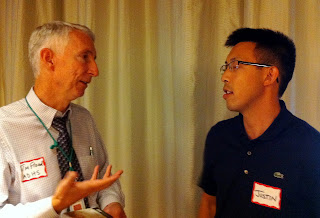 This past Friday, a group of about 20 community and academic leaders met to discuss how to best address the many disparities related to cancer here in Arizona. The meeting, held at the Talking Stick Resort, included a lively discussion about the need for enhanced collaboration, advocacy and education. Dr. Tim Flood (pictured with Justin Tai, APCA Public Ally) provided profiles of cancer disparities by racial/ethnic group as a lead-in to the facilitated discussion. The Cancer Health Disparities group is a subcommittee of the Arizona Cancer Control Coalition, led by the Arizona Department of Health Services.
Doug Hirano, MPH, APCA Executive Director
Once every two years, the Arizona Department of Health Services releases a report entitled “Differences in the Health Status Among Race/Ethnic Groups, Arizona." The latest edition has just been released, and I would recommend that anyone interested in Arizona health disparities give it a quick review. It’s a comprehensive source of comparative health statistics by race/ethnicity.
As in previous editions, data for Asian Americans is not disaggregated by ethnicity. This masks poor health indicators by ethnic subgroup, leading to very good health rankings for Asian Americans as a whole. Indeed, Asian Americans rank “better than average” in more indicators than any other racial/ethnic group.
That being said, the report is definitely worth a review. Credit should be given to the state health department for continuing to publish this important information.
Here’s an excerpt from the report:
In 2009, Asian residents of Arizona ranked best or second best among race/ethnic groups on 53 of 70 indicators, including measures of utilization of prenatal care services, low infant mortality, low incidence of teen pregnancies, and reportable diseases. Asians median age at death was the second highest among the race/ethnic groups in Arizona in 2009. Asians also had the lowest risk of injury mortality in motor vehicle accidents, as well as drug-induced deaths and firearm-related mortality. In 2009, not a single Asian or Pacific Islander of the State died from human immunodeficiency virus (HIV) disease. However, following an improvement in their overall score from -21.9 in 2005 to -37.4 in 2007, the 2009 average score of -29.2 signified no further improvement. The rate of fall-related deaths jumped from 3.9 in 2000 to 10.8 in 2009 (See Comparative Rates and Ratios for 2000-2009). The total mortality rate of 472.8 deaths per 100,000 Asian or Pacific Islander residents of the State was the lowest rate among the race/ethnic groups, but it was the highest rate for Asians since 2005. So were the mortality rates for cancer, chronic lower respiratory diseases, diabetes, and fall-related injuries.
APCA will soon be reviewing its progress on goals and objective in its two-year strategic plan (2009 – 2010), and data from this report will be an important source of information in developing future goals and objectives.
-Doug Hirano, MPH, APCA Executive Director
We have been working closely with the Arizona Cancer Registry of the Arizona Department of Health Services (ADHS) for the past two years. The result is a brief report entitled “Cancer Cases by AAPI Race Distribution 1995 – 2007” that examines cancer reporting by ethnic subgroup of Asian Americans and Pacific Islanders in Arizona. The report makes a case that reporting of specific AAPI subgroups can help with cancer control efforts. Here’s a directive from ADHS that will be released in conjunction with the report:
The Arizona Department of Health Services (ADHS) reminds physicians to list the specific race of patients when sending disease reports to the Department. Race-specific information is important for planning and delivering effective public health programs. It also can be helpful at the clinical level. For example, persons born in Korea or China have an elevated risk for cervical cancer, and rates of stomach cancer are elevated in China and Japan. Unfortunately, the use of the generic term “Asian” without further specification has increased from 35% in 1995 to 50% in 2007. The Arizona Cancer Registry is partnering with the Asian Pacific Community in Action to promote the collection of demographic data regarding patient race, Hispanic ethnicity, tribal affiliation, and place of birth. When these factors are framed as clinically important, patients are unlikely to perceive the questions as intrusive. Including these data elements in the patient registration form or physician notes will greatly facilitate the accurate classification of patient race.
As a colleague once stated, there is a lot of suffering hidden by the aggregation of the many AAPI ethnicities and nationalities into a monolithic category of “Asian/Pacific Islander”. We strongly support disease reporting by the racial/ethnic categories as outlined in guidelines developed by the federal Office of Management and Budget.
We thank the Arizona Cancer Registry, and Dr. Tim Flood and Ms. Lana Khatib specifically, for their generous assistance in developing and disseminating this report.
- Doug Hirano, MPH, APCA Executive Director

 This past Friday, a group of about 20 community and academic leaders met to discuss how to best address the many disparities related to cancer here in Arizona. The meeting, held at the Talking Stick Resort, included a lively discussion about the need for enhanced collaboration, advocacy and education. Dr. Tim Flood (pictured with Justin Tai, APCA Public Ally) provided profiles of cancer disparities by racial/ethnic group as a lead-in to the facilitated discussion. The Cancer Health Disparities group is a subcommittee of the Arizona Cancer Control Coalition, led by the Arizona Department of Health Services.


 Posts
Posts

