skip to main |
skip to sidebar
I very recently received an invitation to a White House reception that will be recognizing Asian American and Pacific Islander heritage. It appears that President Obama and the First Lady will both be in attendance. Invitations were made to Asian American and Pacific Islander community leaders, and I’m proud to be considered in that grouping.
Will I be attending? Who could turn down an invitation that starts with “The President and Mrs. Obama request the pleasure of your company . . . ”?
In any case, if I have a chance to speak at any length with President Obama, I think I will remind him that five million Americans are currently infected with hepatitis B or hepatitis C, and that these individuals will need medical monitoring for the remainder of their lives because of their high risk for serious liver disease. I will let him know that many of these individuals are among the working poor or unemployed who do not have health insurance and cannot afford medical care. I will remind him that exemplary government programs like the Ryan White CARE Act support medical care and treatment for low-income individuals with HIV/AIDS, but no such program exists for individuals with hepatitis B or C. I will remind him that more than half of the 1.4 million individuals chronically infected with hepatitis B are Asian Americans and yet there is virtually no large-scale public health effort to encourage Asian Americans to get screened for hepatitis B or to educate physicians to offer screening to these individuals.
I think I will remind him that Title VI of the Civil Rights Act assures individuals of language access in health care facilities that receive federal dollars, yet thousands of individuals are denied these services on a daily basis in facilities throughout the nation. I will remind him that Asian Americans and Pacific Islanders are the fastest growing racial/ethnic groups in this country and that while health care facilities are doing better in offering culturally competent services to Hispanic Americans, Asian Americans and Pacific Islanders are a virtual afterthought when it comes to culturally competent care.
Lastly, I think I will thank him profusely (and offer a fist bump) for his leadership and vision on the Affordable Care Act and let him know that our agency is actively supporting its continuation. Having said that, I will let him know that the same political will exerted on the ACA will be more than sufficient to address the continuing health disparities related to hepatitis and language access. I will humbly offer my assistance, proffer my business card, and then wander off in search of hors d’oeuvres.
- Doug Hirano, MPH, APCA Executive Director
According to a recent New York Times article, the Arizona Medicaid program, known as AHCCCS, is considering charging a $50 fee to smokers and obese individuals. This would apply only to childless adults. The idea is that since both smoking and obesity lead to preventable disease and illness and increased health care costs then why not have such individuals pay more for their coverage?
On the surface, this seems reasonable. An extra $50 fee might be just the incentive individuals need to make lifestyle changes relating to tobacco use, healthy eating and active living. If they make the needed changes to quit smoking and/or lose weight, then everyone wins – they’re healthier in the long run, and AHCCCS incurs less medical costs. If they don’t manage to make the behavior changes, then at least the State of Arizona can apply the extra revenue from the fees to partially offset the additional health care costs these individuals incur.
However, the third alternative is perhaps the most worrisome. If they don’t have the extra $50 to spare and can’t make the changes needed, then they will be deterred from receiving health insurance coverage. These individuals are indeed at increased risk for illness and therefore have a disproportionately high need for routine medical care – the very care that can help them quit smoking or work to drop some pounds. Perhaps AHCCCS should consider offering smoking cessation assistance and weight management counseling to all those who would be impacted by this new policy prior to its implementation?
Also, one could argue that obesity is not purely an individual behavioral choice. Genetics do come into play, and studies indicate that the economic, social and physical environment in which people live can influence obesity-related behaviors such as diet and physical activity. To a lesser extent, tobacco use is a product of both individual choice and environmental circumstance. In my mind, though, obesity is perhaps too far outside an individual’s choice to make it a logical candidate for penalization through a fee.
Lastly, I found it interesting that this fee would only be applied to childless adults. Don’t obese and smoking parents also incur greater health care costs related to their obesity and tobacco use? In fact, wouldn’t decreasing tobacco use among parents decrease the likelihood of secondhand smoke exposure among children?
In any case, one has to give credit to AHCCCS for thinking creatively about both revenue stream and health-related behaviors. It will be curious to track the impact of this proposal if it gets implemented.
- Doug Hirano, MPH, APCA Executive Director
 The Centers for Disease Control and Prevention recently released a blog post about how to prepare for an attack of zombies. Tongue firmly in cheek, the CDC is trying to attract the attention of the general public regarding preparations for a real emergency. Apparently, they are succeeding. This particular blog post was so popular it crashed their server. I guess the public has an appetite for news about the undead, and, I guess the normally staid scientists at the CDC actually do have a sense of humor.The Asian Pacific Community in Action is taking a more traditional approach to emergency preparedness. Through the leadership of APCA Special Projects Coordinator, Ms. Yen Nguyen, we have recently organized a coalition of Asian American and Pacific Islander community members around emergency preparedness. This coalition will work to better prepare the AAPI community for emergencies of all kinds (e.g., biological terrorism and natural disasters) in a manner that is culturally responsive. However, it should be noted that we make no promises about preparations for attacks of zombies. You’ll have to contact the CDC about that. To find out more about our emergency preparedness initiative, contact Ms. Yen Nguyen at (480) 626-3065 or at yen@apcaaz.org
-Doug Hirano, MPH, APCA Executive Director
An article recently published in New York magazine is all the rage among Asian Americans on the Internet. The article, “Paper Tigers: What happens to all the Asian-American overachievers when the test taking ends?”, offers insight into being a member of the “model minority”. The author, Wesley Yang, examines life’s options for high performing Asian American students, and he doesn’t necessarily paint a pretty picture. He cites the racial bias that makes it more difficult for Asians to be admitted into Ivy League schools, and he references the “bamboo ceiling” that keeps Asian Americans from rising to corporate upper management because while technically skilled, they are often perceived as lacking the charisma and networking skills associated with leadership positions. He provides the data below:
“According to a recent study, Asian-Americans represent roughly 5 percent of the population but only 0.3 percent of corporate officers, less than 1 percent of corporate board members, and around 2 percent of college presidents.”
While I find the content of the article interesting, I think it is perhaps more significant that the piece made it as the cover story of New York magazine. I would suspect that Amy Chua, the Tiger Mom (Battle Hymn of the Tiger Mother), has much to do with this, since Yang’s article is also a rebuttal to the extreme work ethic espoused by Chua.
If nothing else, this article has stimulated discussion within the Asian American community and perhaps will provide a point of reference for mainstream Americans in viewing Asian Americans as individuals with needs that sound startlingly American – upward mobility at work, social lives, and an ability to feel comfortable in your own skin.
-Doug Hirano, MPH, APCA Executive Director
 Our annual fundraising dinner, “A Taste of Asia”, has come and gone. Held this past Saturday at the Doubletree Paradise Valley Resort, the dinner was successful on multiple fronts. The Asian appetizer reception was quite lively and included the successful sale of almost all 60 or so silent auction packages. The dinner program went smoothly. As usual, our hosts, Ethel Luzario and Ted Namba, did a wonderful job keeping the program moving along. I think our honorees – Steve Sanghi, Mr. and Mrs. Dennis Yee, and Asian American WWII veterans – felt good about their portion of the program. Each had a nice digital video segment and a chance to say a few words. Our major sponsors – Wells Fargo, APS, Blue Cross/Blue Shield, and Gilead Sciences – seemed pleased. Lastly, the talent competition was engaging and had quite a diverse group of participants. In the end, our “face changing” participant triumphed ahead of a number of surprisingly talented participants. All in all, it was indeed an affair to remember.
-Doug Hirano, MPH, APCA Executive Director

My friend and colleague Mr. Fred Taylor invited me to be on his radio show, Men’s Health, yesterday. I was happy to speak about health issues in the local Asian American and Pacific Islander communities and did my best to share what I knew about our mission and related activities towards improving the health of Asian Americans and Pacific Islanders. However, I guess you never know what to expect on live radio. Fred’s co-host, Dr. Bob Gear (pictured on right), had some interesting questions for me about sanitation practices in local Chinese restaurants and also related to illegal immigration among Asians in Arizona. I think my responses to these questions were politic. In any case, I’m hoping I won’t be getting any phone calls from Sheriff Joe Arpiao or the Chinese Restaurant Association any time soon.
-Doug Hirano, MPH, APCA Executive Director
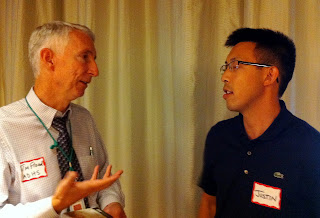 This past Friday, a group of about 20 community and academic leaders met to discuss how to best address the many disparities related to cancer here in Arizona. The meeting, held at the Talking Stick Resort, included a lively discussion about the need for enhanced collaboration, advocacy and education. Dr. Tim Flood (pictured with Justin Tai, APCA Public Ally) provided profiles of cancer disparities by racial/ethnic group as a lead-in to the facilitated discussion. The Cancer Health Disparities group is a subcommittee of the Arizona Cancer Control Coalition, led by the Arizona Department of Health Services.
Doug Hirano, MPH, APCA Executive Director





 Posts
Posts

